

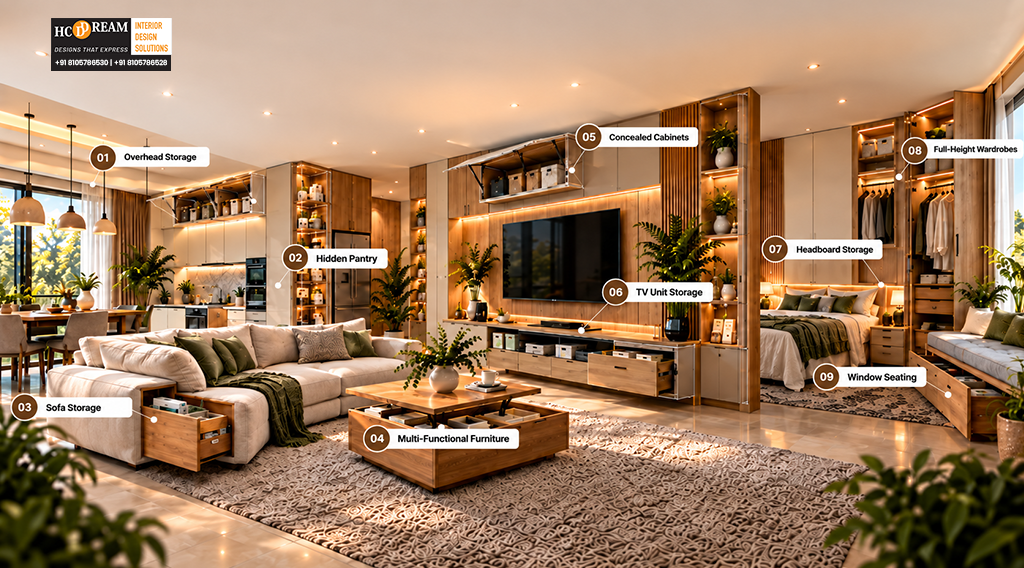
What if your home could hold more without becoming bigger?
The secret is not always adding another cabinet or finding a larger room. Sometimes, the best storage opportunities are already around you… above eye level, beneath furniture, inside unused corners and within spaces you simply have not planned properly.
For modern Bangalore homes, where every square foot matters, thoughtful storage can make the difference between a home that feels crowded and one that feels calm, organised and effortlessly stylish.
These smart storage ideas can help you make better use of the space you already have without sacrificing the look or comfort of your interiors.
Why Smart Storage Matters in Modern Homes
Storage is more than a practical requirement. It can influence how spacious, comfortable and organised your home feels.
When everyday belongings have a designated place, surfaces remain clearer and rooms become easier to maintain.
The challenge is finding storage that works without making your interiors feel like a collection of cupboards.
Good storage should:
- Use overlooked areas
- Keep frequently used items accessible
- Hide visual clutter
- Support everyday routines
- Complement the overall design
- Make cleaning and maintenance easier
The best home storage solutions are often the ones that blend so naturally into the interiors that you barely notice them.
10 Smart Storage Ideas That Don’t Need Extra Space
1. Take Storage All the Way Up
Look around your home.
There may be valuable storage space sitting above your eye level.
Full-height wardrobes and cabinets make use of vertical space that would otherwise remain empty.
This works particularly well in bedrooms.
Instead of stopping a wardrobe several feet below the ceiling, extend it upwards and use the upper sections for items you do not need every day.
What Can Go Up There?
- Suitcases
- Winter clothing
- Extra bedding
- Festival decorations
- Travel accessories
- Seasonal belongings
You do not need daily access to everything you own.
Using higher storage for occasional-use items keeps the lower sections convenient while increasing your overall capacity.
2. Make Your Bedroom Wardrobe Work Harder
A wardrobe is not simply a place to hang clothes.
With the right internal planning, the same footprint can accommodate considerably more.
Instead of creating one large open compartment, divide the wardrobe according to how you actually use it.
Consider dedicated sections for:
- Hanging clothes
- Folded clothing
- Shoes
- Handbags
- Accessories
- Watches and jewellery
- Luggage
- Seasonal items
Pull-out accessories, adjustable shelves and drawers can make smaller wardrobes significantly more efficient.
The important point is to plan the inside as carefully as the outside.
3. Use the Space Under Furniture
The area beneath furniture is frequently overlooked.
Beds, sofas, benches and window seats can all provide opportunities for additional storage.
A bedroom bed with integrated drawers, for example, can provide a useful place for bedding, seasonal clothing or other less frequently used items.
Other Possibilities
- Storage ottomans
- Bench seating with compartments
- Beds with drawers
- Coffee tables with concealed sections
- Built-in window seating
The advantage is simple: you are adding storage without increasing the room’s footprint.
4. Turn the Entrance Into a Storage Zone
The entrance of a home is often one of the first places where clutter appears.
Shoes, keys, bags, helmets and everyday accessories can quickly collect near the door.
A compact entryway storage solution can give these items a designated home.
Consider:
- Slim shoe cabinets
- Floating drawers
- Wall-mounted key organisers
- Closed storage benches
- Hooks for everyday bags
- Small overhead cabinets
For smaller Bangalore apartments, a well-designed entrance can immediately make the entire home feel more organised.
5. Use Dead Corners Intelligently
Every home has corners that are difficult to furnish.
Instead of treating them as wasted space, look at what they could become.
A narrow corner might accommodate a tall cabinet. An awkward wall can become a compact shelving zone. The space beside a wardrobe may work for accessories or cleaning supplies.
Think Beyond Standard Furniture
Custom-designed storage can be shaped around unusual walls, columns, alcoves and room proportions.
This is particularly useful when standard furniture leaves awkward gaps.
A few centimetres here and there may not seem important individually, but across an entire home, these unused areas can add up.
6. Choose Floating Storage
Floor-to-ceiling storage is not the only way to maximise capacity.
Floating units can use wall space while keeping the floor visually open.
This can make a room feel lighter, particularly when working with smaller dimensions.
Floating storage can work well for:
- Bedside tables
- Living room consoles
- Study areas
- Bathroom cabinets
- Entryway organisers
- Display units
It also makes cleaning beneath the furniture easier.
Keep It Visually Balanced
The goal is not to cover every wall.
Use floating storage selectively and combine closed compartments with carefully chosen open areas.
That keeps the room functional without creating visual heaviness.
7. Create Hidden Storage in Plain Sight
Some of the most effective storage does not look like storage at all.
A beautifully designed TV unit can conceal electronics, cables and everyday belongings. A window bench can hide useful compartments beneath its seating.
Similarly, a full-height wall unit can combine display areas, drawers and closed cabinets into one cohesive design.
Hidden Storage Works Best When:
- The room needs a clean appearance
- You want to reduce visible clutter
- Storage needs to blend with the architecture
- You have limited floor space
- You want frequently used items nearby but out of sight
This is one of the reasons concealed storage continues to be popular in contemporary interiors.
8. Give the Kitchen Every Inch
Kitchens often have some of the highest storage demands in a home.
Cookware, appliances, groceries, utensils and cleaning supplies all compete for space.
The answer is not necessarily a larger kitchen.
It is better planning.
Consider:
- Tall pantry units
- Pull-out drawers
- Corner storage
- Drawer organisers
- Appliance garages
- Overhead cabinets
- Internal baskets
- Narrow pull-out units
Deep cabinets can sometimes become difficult to use because items disappear into the back.
Well-organised drawers and pull-outs can make more of the available depth accessible.
9. Turn Hallways and Transitional Areas Into Storage
Hallways are usually treated as circulation areas, but some can accommodate surprisingly useful storage.
A shallow cabinet along a suitable wall can provide space for books, linens, cleaning supplies or household items.
The key is proportion.
Storage in a passage should remain shallow enough to preserve comfortable movement.
Good Options Include:
- Slim cabinets
- Floating shelves
- Built-in niches
- Closed linen storage
- Narrow display-and-storage units
This approach turns an otherwise passive area into a useful part of the home.
10. Design Multi-Functional Furniture
When space is limited, one piece of furniture can perform several jobs.
A study desk can include drawers and shelving. A bench can provide seating and storage. A bed can combine sleeping space with drawers.
This approach reduces the number of individual furniture pieces needed while increasing functionality.
Examples of Multi-Functional Design
Bedroom: Bed + storage + bedside functionality
Living Room: Seating + hidden storage
Study: Desk + shelving + closed cabinets
Dining Area: Bench seating + storage
Entryway: Seating + shoe storage + accessories
Multi-functional furniture is especially useful in compact apartments because it allows you to gain functionality without adding visual clutter.
How to Make Storage Feel Like Part of the Interior
Storage should not look like an afterthought.
The most successful solutions are integrated into the overall design language of the home.
Use consistent finishes, proportions and colours where appropriate so that cabinets feel like part of the architecture rather than separate objects placed inside a room.
For example, a full-height wardrobe in the same finish as surrounding cabinetry can visually blend into a bedroom.
Similarly, a wall-mounted living room unit can be designed around the television, lighting and décor rather than treated as a standalone cabinet.
Don’t Turn Every Wall Into Storage
More storage does not automatically mean better storage.
Covering every available wall with cabinets can make a room feel visually heavy.
Instead, create a balance between:
- Closed storage
- Open shelving
- Empty wall space
- Decorative elements
- Natural light
A home needs breathing room.
The goal is to store more while making the room feel less crowded.
Storage for Small Bedrooms
Bedrooms are often where storage challenges become most obvious.
Clothing, accessories, bedding, luggage and personal items all need a place, while the room still needs to feel restful.
A Few Effective Bedroom Strategies
- Use full-height wardrobes
- Add storage beneath the bed
- Choose compact bedside units
- Use vertical wall space
- Create dedicated accessory drawers
- Keep seasonal items higher up
- Use sliding wardrobe shutters where appropriate
Avoid placing too many standalone cabinets around the room.
Integrated storage usually creates a cleaner and more cohesive appearance.
Storage That Supports Everyday Life
Good storage should make routines easier.
Think about the moments when you naturally put things down.
Keys near the entrance. Bags near the door. Laundry near the bedroom. Daily kitchen appliances close to preparation areas.
Storage becomes much more useful when it is located where the activity actually happens.
This principle can transform a home.
Instead of asking, “Where can I fit another cabinet?”
Ask:
“Where would it be easiest for me to put this away?”
That small change in thinking can lead to much better planning.
Smart Storage Mistakes to Avoid
Even well-designed storage can become frustrating if certain details are overlooked.
Too Much Open Shelving
Open shelves look attractive but require regular organisation and cleaning.
Deep Storage Without Organisation
Large, deep compartments can become difficult to access.
Ignoring Vertical Space
Leaving the area above cabinets unused wastes valuable capacity.
Designing Storage Without Measuring Belongings
A shelf may look adequate until you actually try to store your items.
Prioritising Appearance Over Access
Storage should look beautiful, but it must also be easy to use.
Are Custom Storage Solutions Worth It?
For many homeowners, custom storage can be valuable because it allows the design to respond precisely to the room.
Instead of adapting your belongings to standard cabinet dimensions, storage can be planned around your lifestyle, available space and specific requirements.
Custom solutions can be particularly useful for:
- Compact bedrooms
- Unusual room layouts
- Small apartments
- Awkward corners
- Large storage requirements
- Multi-functional spaces
The value comes from using the available space more intelligently… not simply from having more cabinets.
Storage Trends for Modern Bangalore Homes
Storage design is becoming increasingly integrated with architecture.
Some of the trends influencing contemporary homes include:
- Full-height cabinetry
- Minimal handle designs
- Concealed storage
- Modular internal wardrobe systems
- Multi-functional furniture
- Floating furniture
- Integrated study units
- Built-in utility storage
- Clean, seamless cabinetry
The common thread is visual simplicity.
Modern homeowners increasingly want storage that provides functionality without dominating the room.
Why Professional Planning Makes a Difference
Storage may seem straightforward, but getting the proportions, access and placement right requires careful planning.
A professional design team considers the entire home rather than treating each cabinet as an individual decision.
If you are searching for the Best Interior Design Company in Bangalore, look for a team that understands how storage interacts with layouts, lighting, furniture and your lifestyle.
When comparing options for the Best Interior Designer in Bangalore, consider whether the designer asks about what you need to store… not just what style you prefer.
Homeowners searching for Interior Designers Near me Bangalore should also look at the complete process, including design development, material selection and execution.
For homeowners in East Bangalore, those looking for the Best Interior Designers in Whitefield Bangalore can benefit from working with a team experienced in modern apartments and contemporary urban homes.
How HCD DREAM Interiors Approaches Storage
At HCD DREAM Interiors, storage is treated as part of the overall home design rather than something added at the end.
From bedroom wardrobes and kitchen cabinetry to living room units, study spaces and utility areas, every storage decision can be considered alongside the home’s layout and aesthetic.
The objective is simple: make better use of the space you already have while keeping the home visually calm and comfortable.
A well-designed home does not need to reveal how much storage it contains.
It simply feels organised.
FAQs
1. How can I maximize storage in a small home?
Use vertical space, full-height cabinets, under-furniture storage, multi-functional furniture, hidden compartments and carefully planned built-in units. The key is to use overlooked areas without overcrowding the room.
2. Which rooms need the most storage planning?
Bedrooms, kitchens, living rooms, entryways and utility areas usually require the most consideration. Each has different storage requirements, so solutions should be based on how the space is actually used.
3. Are custom storage solutions worth it?
Custom storage can be worthwhile when you have limited space, unusual room dimensions or specific storage requirements. It allows cabinets and furniture to be designed around your space rather than forcing your home to accommodate standard dimensions.
4. How do hidden storage solutions work?
Hidden storage integrates compartments into furniture, walls or cabinetry so that belongings remain accessible without being visually exposed. Examples include storage beds, concealed TV units, built-in benches and integrated cabinets.
5. What are the latest storage trends?
Current storage approaches increasingly focus on seamless cabinetry, full-height storage, concealed compartments, modular wardrobe interiors, floating furniture and multi-functional pieces that combine storage with other uses.
Create More Space Without Adding More Space
Your home may already have more storage potential than you realise.
If you are planning a new apartment interior, renovating your existing home or looking for smarter ways to organise your bedroom and living spaces, HCD DREAM Interiors can help you make every square foot work harder.
From thoughtful space planning and custom storage to complete turnkey interiors, the focus is on creating a home that feels beautiful, organised and effortless to live in.
Ready to unlock the hidden storage potential of your home? Connect with HCD DREAM Interiors and start designing a smarter space today.